
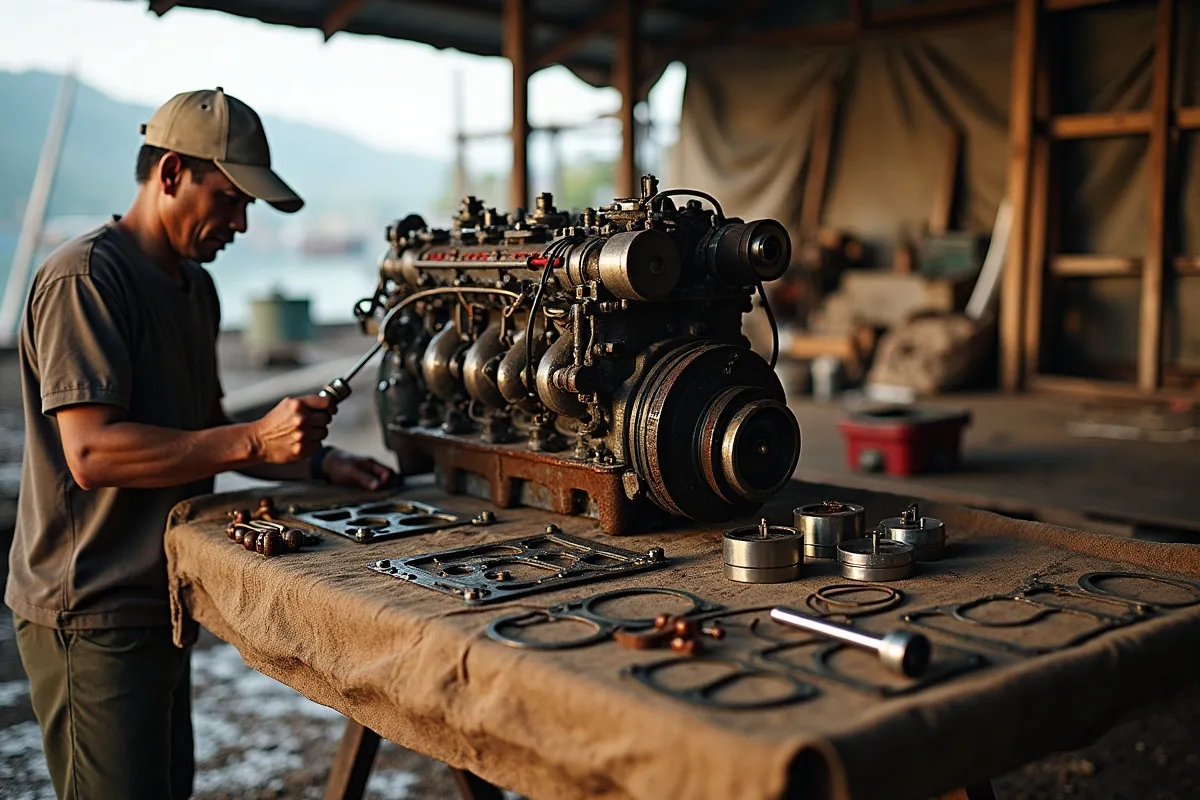
Every engine in the Komodo charter fleet lives the same hard life: daily starts, long idling at anchorages, warm intake air and tropical cooling water. Hours pile up fast, and the difference between a planned overhaul and a mid-season failure is measured in lost charters. This article is about the scheduling craft — when to open an engine in Labuan Bajo, how to sequence the work with yard time, and what the numbers look like when it is planned instead of forced.
Why Timing Beats Everything Else
An overhaul done in the wet season costs the same labour as one done in July — but the July version also costs the charters the boat missed. The fleet’s natural window is roughly December to March, when the north-west monsoon thins bookings anyway. The constraint is that everyone knows this: mechanics, machine shops and slipway slots all book out. Operators who confirm their overhaul plan by October get first choice of dates and sea freight for parts; those who decide in January join the queue and pay air freight.
Reading the Engine: Overhaul Triggers
Hours alone do not decide an overhaul; condition does. The triggers we act on are falling compression across cylinders, blow-by pressurising the crankcase, oil consumption trending up, cooling temperatures creeping under the same load, and injector patterns going ragged. A between-seasons check — compressions, oil analysis, a look at the turbo if fitted — sorts engines into “service and run”, “top-end this window” or “plan the rebuild”. Our diesel engine repair notes cover the diagnostic side; the point here is that the decision should be made months before the spanner turns.
Top-End or Full Rebuild: Scoping the Job
A top-end overhaul — cylinder heads off, valves and seats refaced, injectors serviced, new gaskets — keeps a healthy block earning for years and usually fits inside two to three weeks including machining. A full rebuild goes to the crankshaft: pistons, liners, bearings, oil pump, heat exchangers, the lot. That is a four-to-eight-week story once machining and parts shipping are counted, and it deserves honest comparison against repowering with a new engine — a conversation we have openly with owners, including folding bigger projects into a planned yacht refit window. Generators get the same logic on a smaller scale, alongside engine room repair items like mounts, exhausts and plumbing that are easiest and most economical to renew while the engine is out.
Sequencing Engine Work with Yard Time
The efficient pattern pairs the overhaul with the annual slip. Hull trades work outside — antifouling, caulking, stern gear — while mechanics work inside, and the vessel returns to service in one lay period instead of two. That pairing also catches interactions a single-trade plan misses: shaft alignment is checked after engine mounts are renewed, exhaust risers are matched to the rebuilt engine, and fuel tanks are cleaned before a fresh fuel system meets old sludge, per our fuel system repair guidance. Many operators fold this into a wider refit portfolio — interiors, electrics and machinery staged over two or three seasons — which is exactly the planning covered in our yacht refit guide.
Budgeting and the Parts Chain
Indicative USD bands, confirmed after inspection: top-end overhaul USD 2,000–6,000; full rebuild USD 8,000–20,000 depending on engine make and machining needs; generator overhauls proportionally less. The silent budget line is logistics — gasket sets, liners and injectors reach Flores through the chain described in spare parts sourcing, and sea freight versus air freight can swing a project by four figures. We order long-lead parts on deposit before the vessel stops, verify everything against the engine’s serial plate, and hold the machining slot so strip-down flows straight into measurement. After reassembly, a loaded sea trial proves temperatures and smoke before the boat takes guests again.
Frequently Asked Questions
When should I book a between-seasons engine overhaul in Labuan Bajo?
Confirm scope by October and book for December–March. That secures mechanics, a slipway slot if hull work is paired, and sea-freight timing for parts — the three things that vanish once the whole fleet wants the same window.
How many engine hours before an overhaul is due?
As a rough tropical-service guide, top-end attention often falls due around 5,000–8,000 hours and major overhaul thinking around 10,000–15,000, but condition evidence — compression, blow-by, oil analysis — always outranks the hour meter.
Can the overhaul happen without hauling the boat out?
Yes, engine work itself can be done alongside. But pairing it with the annual slip in one lay period saves a second stoppage, and mount or alignment work is best finished while hull access is easy — see our haul-out guide.
Overhaul or repower — how do you advise owners?
We compare honestly: rebuild cost against a new engine’s price, parts availability for the old block, fuel burn and resale value. Past a certain machining bill, repowering wins; we give both numbers and let the owner decide.
To plan an overhaul window, message WhatsApp +62 811 3941 4563 or email bd@juaraholding.com with your engine make, model and hours — or use our contact page. Wooden-fleet owners can pair the work through our phinisi shipyard guide; visiting vessels start at yacht shipyard services.