
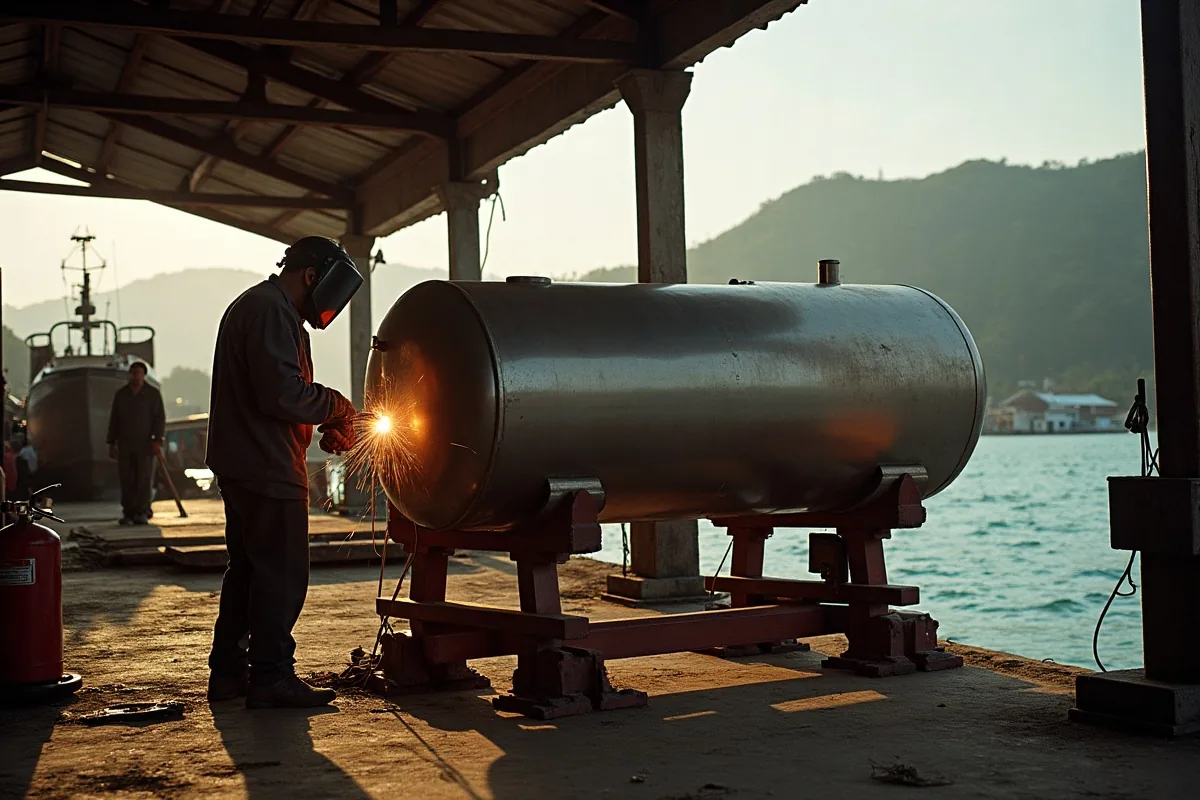
Labuan Bajo’s fleet is famous for timber, yet almost every vessel here floats on a quiet inventory of welded metal: tanks below the cabin sole, davits over the transom, exhaust runs through the lazarette, chainplates buried in the rig. When that metal cracks, corrodes or needs upgrading, the job lands with the welding shop. This article explains what marine welding at the Komodo gateway involves, how we control quality so far from the big industrial centres, and what owners should budget — building on the fabrication work described in our shipyard welding services page.
Steel Work in a Wooden Fleet
The commonest calls are not dramatic. Mild-steel fuel tanks weep at a seam after fifteen years; a stainless davit fatigues where the dinghy has been swung twice a day every season; an engine bed bracket cracks along an old repair. Wooden hulls add their own metalwork: floors and strap fastenings, mast tabernacles, rudder fittings and the steel cradles the hulls sit on during a slip. Because the underlying vessel is timber, every hot-work decision also becomes a fire-control decision — one reason welding jobs here are planned rather than improvised, following the controls in our yard safety standards.
Processes and Materials at the Edge
The yard runs stick welding for structural mild steel where wind and position make it the robust choice, MIG for tank seams and longer runs done ashore, and TIG for stainless and thin-wall work where finish and penetration control matter. Materials are the honest constraint of working in Flores: certified plate, marine-grade stainless sections and matched consumables come in from Surabaya on the freight chain described in our parts logistics guide, so material orders go in the moment a repair is scoped. Aluminium work is assessed case by case; large aluminium fabrications are routed to partner facilities in Bali or Java.
Hot Work Afloat Versus Ashore
Where possible we bring the job ashore — a tank cut out during a scheduled haul-out can be rebuilt on the bench, pressure-tested and reinstalled with proper coatings. Afloat, hot work follows a permit routine: fuel isolated, spaces ventilated and gas-checked where tanks are involved, fire watch posted with extinguishers staged, and timber surfaces shielded with wet blankets. Some jobs simply should not be welded afloat, and we say so; a temporary mechanical repair gets the vessel to the slip, and the permanent weld happens on the hardstand.
Quality Control Without Shortcuts
Distance from the certification hubs is no excuse for guesswork. Critical joints get dye-penetrant checks; tanks are pressure- or leak-tested before reinstallation; welds on rig attachments and rudder fittings are inspected with the surveyor when one is attending, and photographed for the vessel’s file either way. Where class or insurance requires certificated procedures beyond the yard’s scope, we are straightforward about it and arrange the work through larger partner yards, with attendance from our survey support team to close the finding formally — the same discipline that runs through storm damage repairs.
Rewiring and Metalwork Travel Together
A surprising share of welding jobs begin as electrical ones. Corroded cable trays, earth faults that have eaten a through-hull fitting, generator beds cracked by vibration — the metal repair and the wiring repair are two halves of the same fault. Where a vessel is due wider electrical work we coordinate both trades in one lay period, as covered in our electrical refit guide, so paint, staging and access are paid for once instead of twice.
What Welding Work Costs
Indicative USD figures, confirmed by quotation after inspection: general marine welding labour runs about USD 25–45 per hour depending on process and position; a typical mild-steel fuel tank rebuild lands between USD 600 and 2,500 with material; stainless davit or fitting repairs commonly USD 150–800. Material and freight are itemised openly. For major steel renewals beyond local slip capacity, the job moves to a partner yard once the hull comes ashore — capacity limits are detailed in our haul-out capacity notes.
Frequently Asked Questions
Can you weld stainless steel to marine standard in Labuan Bajo?
Yes. TIG welding of 316 stainless for davits, rails, tank fittings and exhaust components is routine, with matched filler and post-weld cleaning to limit corrosion. Very large or class-certificated stainless fabrications are arranged through partner facilities.
Is hot work possible while my boat stays in the water?
Often, with controls: fuel isolation, ventilation and gas checks near tanks, fire watch and shielding for timber. Some jobs are refused afloat because the risk is not worth it — those wait for the slip, and we plan a safe interim repair instead.
How do you test a repaired fuel or water tank?
Rebuilt tanks are leak-tested before reinstallation — low-pressure air with soap solution or water fill depending on the tank — then coated appropriately inside and out. Test results and photographs go in the vessel’s job file.
Do you fabricate new items or only repair existing ones?
Both. Tanks, brackets, davit assemblies, exhaust sections, boarding ladders and cradle steel are fabricated to measure at the yard. We work from the old item, your drawings or a template lifted on board, and agree the specification before cutting material.
To scope a welding or fabrication job, message WhatsApp +62 811 3941 4563 or email bd@juaraholding.com with photos of the item and your dates — or use our contact page. For slip-based repairs, see the haul-out and slipway guide.