
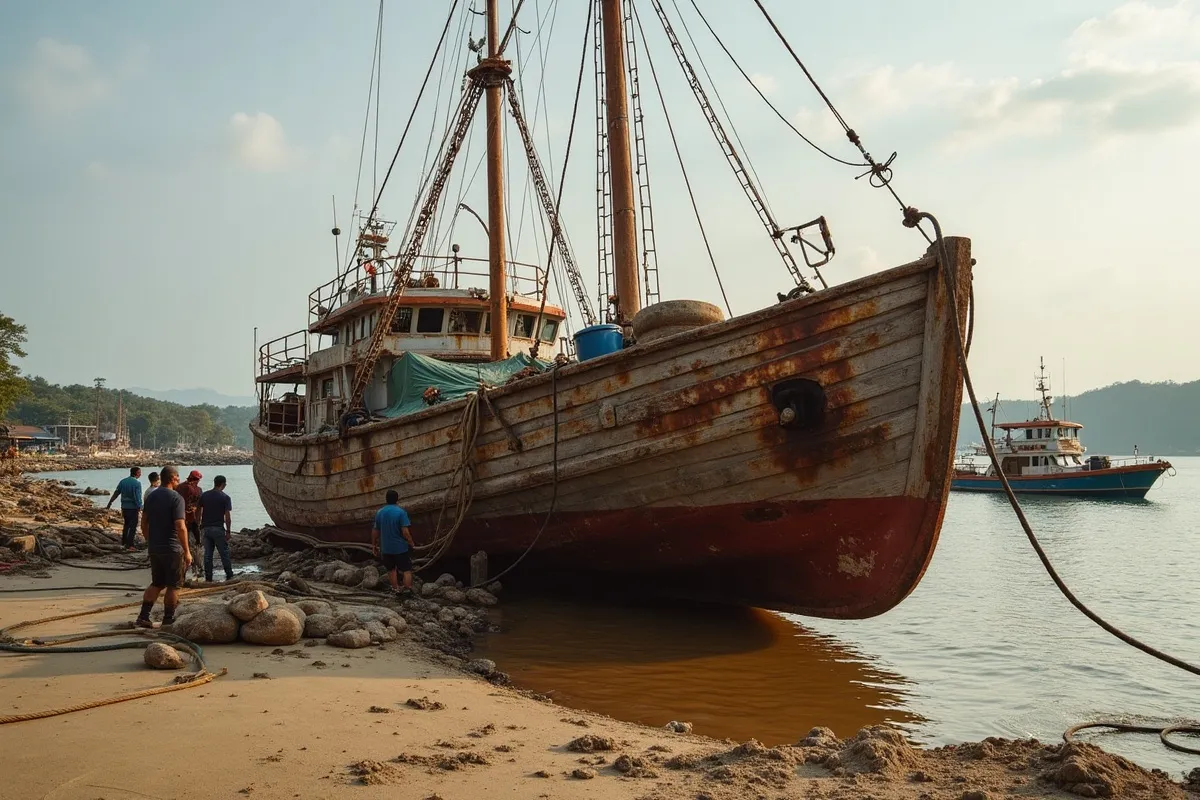
The waters between Labuan Bajo and the Komodo islands are charted, but they are also busy, reef-fringed and swept by serious currents. Boats ground here every season — on falling tides at anchorages, on reef edges misjudged in glare, occasionally driven ashore by squalls. What happens in the hours after a grounding decides whether the story ends with an inspection and some plank work or with a constructive loss. This is how salvage and refloat operations are run properly at the Komodo gateway.
First Response: Stabilise, Don’t Yank
The worst thing done to grounded boats is the instinctive one: a friendly vessel throws a line and pulls. Dragging a hull across coral or rock turns a local holing into a torn-open garboard. The correct first moves are quieter: sound the bilges, check for ingress, sound around the hull to learn what she is sitting on, strip weight if the tide is falling, and set anchors to hold her from working further on. If fuel or oil could escape, containment comes before everything — this is a national park, and pollution turns a marine incident into a legal one. Our emergency call-out team brings pumps, plugs and judgement to that first hour.
Assessing the Casualty Where She Lies
Before any refloat attempt, someone competent looks at the hull — a diver or, on a drying bank, a walk-around at low water. The questions are specific: what is she resting on and where are the point loads; is the hull holed, and can the holes be patched or plugged for the tow; are rudder, shaft and propeller fouled or bent; what does the tide do over the next 48 hours? The answers shape the plan and the equipment list. Where an insurer is involved — and after any real grounding it should be — early photographs and a surveyor’s involvement through survey support protect the owner’s position from the start.
The Refloat: Tide, Buoyancy, Pull — in That Order
A textbook refloat here uses the sea’s own lift. Work is staged at low water: patches and plugs fitted, pumps rigged and proven, lift bags secured where buoyancy is needed, ground tackle laid to haul against. As the spring tide rises, pumps hold the ingress, the bags take their share, and the vessel is eased — not wrenched — toward deep water along the line the assessment chose. Tug or workboat assistance is sized to the casualty. Refloating on the biggest tide of the cycle is often worth waiting a day for; the sea lifts hulls far more gently than any winch drags them.
Straight to the Slipway
A refloated vessel is not a repaired one. Grounding loads work fastenings, start seams and bruise timber in ways bilge-checks afloat cannot see, so the tow ends at the slipway, not the mooring. On the hardstand, the hull inspection maps the true damage: crushed planking, cracked frames, a shaft to draw and check per our stern gear guide, rudder bearings, keel bolts. Wooden hulls go to the phinisi shipwrights for seam and plank renewal. Repairs are quoted in USD per finding; casualties beyond local capacity are refloated first and then moved on — the lift stage follows our vessel haul-out playbook.
Costs, Contracts and the Honest Caveats
No serious operator quotes salvage from a phone description, and owners should be wary of anyone who does. What we commit to is process: attendance and assessment scoped in writing, a refloat plan with equipment and tide windows priced before execution, and repair quotes itemised after the hardstand survey. Simple assists — a kedge laid, a short pull off soft mud with pumps aboard — sit at the modest end; multi-tide operations with lift bags and tugs are scoped case by case. Insurers are kept in the loop throughout, and every stage is photographed the same way our yard work is documented for absent owners.
Frequently Asked Questions
My boat has grounded near Labuan Bajo — what do I do first?
Check crew, then bilges, then stop the boat working further onto the reef: set an anchor, strip weight if the tide is falling, and photograph everything. Do not accept a tow-off before the hull is assessed. Then call us with position and photos.
Why is dragging a grounded boat off so dangerous?
Because the seabed becomes a rasp. Pulling a loaded hull across coral or rock tears planking and opens seams that were merely bruised, and a boat that was stable aground can sink in deep water minutes after coming off.
How long does a refloat operation take?
Simple assists on a rising tide can be done the same day. A properly staged refloat with patching, pumps and lift bags usually spans one to three tide cycles, and waiting for the bigger spring tide often produces a gentler, safer lift.
Does insurance cover salvage and the repairs afterwards?
Most hull policies cover salvage and grounding repairs, subject to prompt notification and evidence. Photograph early, notify the same day, and use surveyor attendance; we coordinate all three so the claim and the repairs move together.
For salvage response or to pre-plan emergency cover for your fleet, message WhatsApp +62 811 3941 4563 (08:00–20:00 WITA) or email bd@juaraholding.com — or use our contact page. The haul-out guide explains what happens once the casualty reaches the rails.